Interview: David M. Lutken - Woody Sez
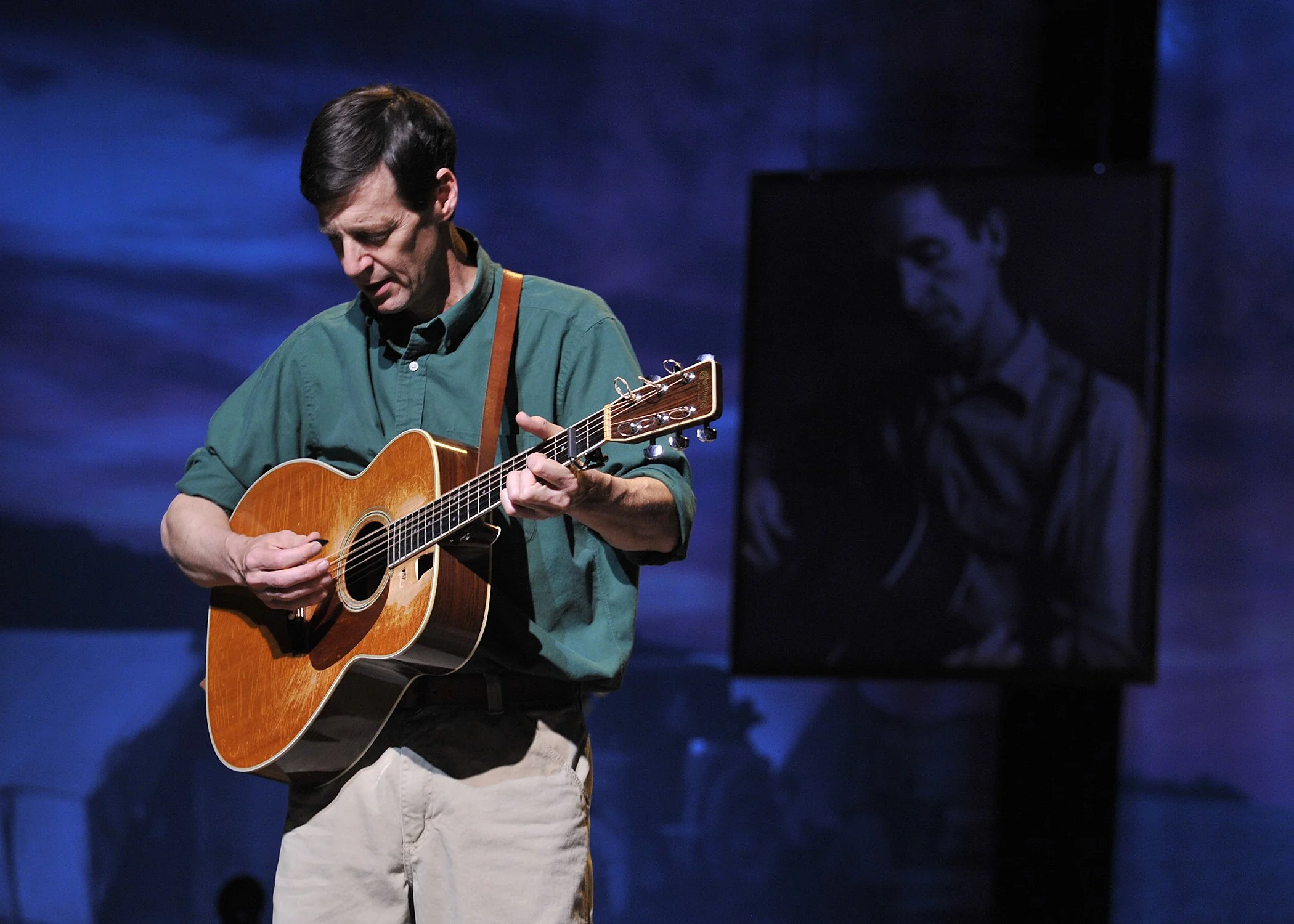
David Lutken was born in Texas, and he and his wife share a deep passion for theatre. The purpose of Woody Sez is to share Woody Guthrie's life, music, and message through an authentic, intimate, and acoustic stage biography.
Ticket link:https://www.edfringe.com/tickets/whats-on/woody-sez
Venue: Cowbarn at Underbelly, Bristo Square
When: 5th - 30th August (not performing on 17th and 24th)
Could you tell us a bit about yourself and the show?
I was born in Texas. I've been an actor and musician for forty years. My wife, Sherry, and I work in theatre – often together; we travel a good deal, and we love the out-of-doors. Woody Sez: The Life & Music of Woody Guthrie has been a terrific collaboration among five people: Darcie Deaville, Helen Jean Russell and Andy Teirstein who are all brilliant multi-instrumentalist/actors – and our original director and co-deviser, Nick Corley, and me.
Woody's former manager, the late Harold Leventhal, had encouraged me to create a new 'biography for the stage' about Woody's life and his music, and had given me a lot of materials to work from, including the book Woody Sez, a collection of the columns Woody had written for the left-wing newspaper the People's Daily World. Darcie, Helen, Andy and I had cut our collective teeth on Woody and American folk music, and in 2007, because of the producer Pierre Cossette and his wife, Mary, we had the opportunity to come to Edinburgh. I called my very talented friend, Nick, who comes from a theatre background, to be our director. All of us began to work on the script with only weeks to go. It grew from there – in 2011 we opened at the Arts Theatre in London, and in 2017 played Off-Broadway in New York. Still working and changing bits and pieces, 19 years later Woody Sez is back for this year's Fringe, and looking toward new productions in the near future: Underbelly's Fringe Fix at their Boulevard Theatre in Soho, 8th – 19th September, and in October at a wonderful venue only a mile from the White House, in Washington, D.C.
Woody Guthrie's music is from a different era. Why do you think these songs still connect with people today?
Is this a trick question? (Just kidding.) I believe it's because we like to be reminded of great art that has a purpose – whether it's Alvin Ailey or Bertolt Brecht, Ai Weiwei or Thomas Hart Benton, Charles Dickens or Jack Kerouac, Bruce Springsteen or Jesse Wells. Art really can and does change people's minds. Music is such a strong pathway through which to reach folks — as Woody says: "Change the pen and change the ink. Change the way that people think!"
There are only four of you on stage playing over twenty instruments. What are the challenges of doing all of that live while also acting?
The main challenge is keeping everything in tune! Truly, though, it's a wonderful and intricate 'ride' every day. I often say that "rehearsing is cheating", and I'm only half joking. To me, what helps enable an actor/muso to make the shift back and forth is skill and practice, but also the added connection with an audience that an instrument can provide — in Woody Sez, there are four of us on stage, but a bit like a really great pub music session, our "fourth wall" includes and encompasses the audience, too.
Big reviews like The Guardian said your show knocks the big West End biopics in a heap of dust. What makes this smaller, intimate show so powerful?
I'm much obliged to The Guardian for that! Woody Sez is fundamentally different from a lot of other musical biographies in that it's a show about a person who constantly 'wrote himself into other people's shoes'. Simultaneously, he channeled his own feelings and very personal experiences into lyrics that were meant to fight for the rights, freedoms, hopes and needs of everybody – "all sorts of folks just about like you", as he says.
We perform the show with no amplification to emphasise the scale – the ratio of the voice to the message. I chose the title Woody Sez not only because of the inspiration from his political newspaper columns, but also to alter its meaning and shift the focus, to invite audiences to listen not just to the genius of the songs but to hear the words, thoughts, doubts, fears, mistakes, misdeeds, failures and successes, the wonderful wry humour and crippling tragedies, and the hope for "A Better World A-Comin'" – his life, straight from him, and those who knew him best. He was certainly an individualist, but he believed – more than anything, I think – in the deepest kind of human communalism, and that only happens when folks are willing to lean in.
As the show is making its triumphant return to the Edinburgh Fringe, what are you most looking forward to this time around?
We're excited to return to the Fringe (and I very much hope you're right about the "triumphant" part!). I guess I'm most looking forward to being back in the crackling buzz of the Festival – it's been quite a while – seeing others' shows, revues, stand-up, concerts, improv, fire-eating unicycle jugglers – all of it, and singing these songs for (and with!!) our Edinburgh audiences is something anyone would want to do over and over again!
If you could describe the show in three words to make people eager to see it, what would they be?
American, Resistance and Music